
Pinterest is one of the world’s fastest growing social networks, even though some claim it may have growth issues. The site allows people to collect images they find interesting by adding them to their online pinboard. It is easy to ”re-pin” things, as well as share them to other social networks such as Facebook and Twitter.
According to E-WebStyles podcast on Internet Marketing there is something of a Pinterestification of the internet. They see a trend where sites are adopting the Pinterest layout, with increased site visitor duration as a result.
Back in 1997 I wrote a thesis at Stockholm University that examined the journey that traditional media took while adapting to the web. The two or three column layouts, typically found in newspapers at the time, were carried over to the web and have persisted ever since. While examples of alternate compositions can be found, Pinterest has helped to popularize an image centric grid layout.
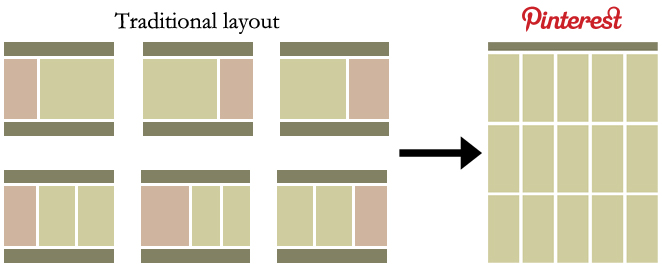
The Pinterestification of the web is not only about a shift in design. It also embodies a deeper meaning about who we are, want to become and what we value in that process.
The Pinterest layout differs from traditional design in that it presents a palette of choices equal in size, rather than one major “in-your-face” item. What we see is not only a shift from regular users becoming authors, and co-producers of value, but visitors given a larger role in creating a more personalized experience. This development resembles that of computer games, changing from pre-defined linear stories to becoming more open-ended (e.g. Skyrim or GTA). Pinterest places an emphasis on images over text, which also leads to more open-endedness.
Our experience of the world has become increasingly global, relativized, fragmentized, de-centralized and pluralistic. As we increasingly lose trust in institutions to guide us, we compensate by carving paths of our own. I want to argue that the Pinterestification of the internet finds appeal because it embodies this endeavor. It symbols a shift from the one true path to many, with the individual in the driver’s seat.
What do you think?.